Saturday, July 14, 2018

Book Review Philosophy

BOOK REVIEW : THE ART OF PHENOMENOLOGY
 
By Anna Yampolskaya, Kairos Ripol Classic Moscow, 2018
 
ИСКУССТВО ФЕНОМЕНОЛОГИИ АННА ЯМПОЛЬСКАЯ
KAIROS МОСКВА, 2018
 
A new book on Philosophy titled: 'The Art of Phenomenology , ' represents a bold
attempt to not only define phenomenology but to widen the discourse to encompass
not only students but artists, writers and anyone not afraid of questioning the very
foundations of their most cherished beliefs. The book is in Russian. It is not light
reading. However, it will appeal to those who like Sartre , Heidegger , Husserl and
Derrida. And that is to name but a few thinkers! Yet given the large number of
highly advanced and sophisticated people in Moscow who often drop into
cafes and libraries to listen to philosophy talks, this book should find an audience.
My experience as a teacher in Moscow readily confirms that there are many
Russians who can quickly grasp complex philosophical ideas.

The book is not just academic. In attempting to draw on the thoughts of philosophers
on topics such as the promises we make to each other, the nature of feelings,
confession, forgiveness and death, it deals with the questions which matter most
to us. But the breath and scope of this book is staggering!

The book begins with the question 'What is Phenomenology?' The author answers
that it, of course, is mainly associated with the philosopher Edmund Husserl. This
daring and passionate philosopher attempted to establish a new 'science of
Phenomenology ' where a person would attempt to study how the actor perceives
the world around him and how he should best study the nature of phenomena.
He argued that consciousness could be selective in that we intentionally draw
our attention to certain things around us. He developed a complex methodology
which would allow the observer to 'bracket ' the most irrelevant things in order to
capture the essence of an object . That is we have to control and contain
prejudices which distort and cloud our perception. Most people take the world
for granted and don't acutely observe things. They could pass the same tree
in a street they'd lived in for years without noticing never mind fully acknowledging
it. But phenomenology sought to explore how consciousness could perceive an
object or person in so many different ways . This led to attempts to create a new
science of mental illness, criminology and, in Heidegger's case, an ontology
of being based on death.

Yampolskaya's work declares that almost anything should be up for debate by
philosophy. Even the very definition of the word is open to debate . I mean is
philosophy 'the love of wisdom ' ? Is it mainly concerned with preparing for
death?' or is it concerned with discovering the truth? Now philosophy has
almost been reduced to subdivision of linguistics ! For instance, an indication
of how far philosophy has been marginalized in Scotland is how students of the
social sciences and natural sciences are no longer obliged to study it for
a year which was previously the case. The study of philosophy which encourages
people to think critically is unwelcome in a society based in an answer all
culture where the answers are already assumed in advance. What matters most
in Britain are the narrow values of effectiveness, efficiency and economic growth.
The subject philosophy is almost a dirty word in many parts of Britain.

A clue to Yampolskaya's own perspective is when she tells how Dante descends
into Hell and fully perceives his woman Beatrice not as an object or his own self
but as a wholly unique person in her own right. 'Dante compares Beatrice with
Christ - but the figure of Christ does not narrow ,nor replace the real humanity
of Beatrice : Beatrice remains herself, and is not turned into a transcendental
idea of beauty and love , and appears herself as an earthly woman.' From this
it follows that we should perceive people as unique beings who are special.

The philosophy of Phenomenology therefore represents a kind of spiritual
effort where we overcome our old egoism and become a new subject or
better person. We should attempt to perceive the person in all his complexity
rather than as a mere object or even an annoying obstacle which gets in our way.

Perhaps the notion that Phenomenology can represent a saner way of doing
philosophy is best illustrated by the warm relationship between Russian philosopher
Leon Shestov and Husserl . He once told his friends in front of Shestov : "No one
has ever attacked me so sharply as he - and that is why we are such close friends".
Husserl not only helped to publish articles by Shestov but got him acquainted with
Kierkegaard. Once he scolded Shestov with the words: "You have turned me into
a stone statue, raised me onto a lofty pedestal, and then with hammer - blows you
have shattered this statue to bits. But am I really so lapidary? " Shestov had
misconstrued and misunderstood Husserl's project and portrayed him as some
kind of soulless rationalist which was far from the case. But Husserl was a very
open-minded person who never took disagreements personally, but on the contrary
welcomed critique of his ideas.

I found the chapter centered around a debate between Derrida and Austin and
Searle's speech act theory intriguing. Austin stated that uttering words does
many things such as make promises , marriages and friends and so causes
significant actions. However, Derrida claimed that speech had been privileged
over the written text and that the words themselves could change their meaning in
such a way the outcome could be open-ended. A word itself can lose its meaning
if the context is no longer available. Searle argued back that Derrida did not
recognize the possibility of rational discourse and agreement between actors
and, worse, was a relativist. However, it would be fairer to state that Derrida
only stressed how highly problematic any form of rational discourse has become.
If you read Alasdair Macintyre's ' After Virtue,' you will notice how much discourse
has become characterized by a self righteous tone where people are speaking
from incompatible perspectives.

One thorny issue which is raised is whether swearing an oath in court 'To tell
the truth, the whole truth and nothing but the truth' ... can be taken seriously.
What if the person does not believe in God or the fact we have a new context
where the country has become secular? Has not the oath lost it's strength of
purpose? Why make promises we can hardly keep? The Philosophers believe
that people are not swearing to the God of Abraham, Issac or Christ but a
' political device.'

Yampolskaya ends her book with a chapter on death. This is perhaps the most
controversial. She states : 'Of all the philosophical problems , the problem of
death presents the closest to non philosophers : we all confront the deaths of
other people and everyone of us knows that sooner or later they are also going
to die. Or to be more exact, everyone is mortal and we try not to think about our
own deaths. However, there are exceptions, philosophers, and to philosophize
means to learn how to die'. In a sense, philosophy is a preparation for death.
However, according to Yampolskaya , this itself is problematic because if I die,
I can't return to learn the errors of how I died. Unless one takes the examples
of returning from the land of the dead seriously. I can only die my own death
and not the death of another person. In a sense, dying is one of the loneliest
experiences. Many people have argued that the intensity of almost dying
sharpens the intensity of their lives and offers a fresh perspective on what
really matters most. Most people dread or fear death . A passage from
Tolstoy's : 'The Death of Ivan Ilyich ' is cited as demonstrating the dread
and fear of dying. Death is feared by some because, to quote Shakespeare's
Hamlet ; 'It is the undiscovered country' . But it is worth asking 'Is death so
dreaded by so many? Is it so trivialized or concealed in discussion?"
It largely depends on how people perceive death! There are a wide spectrum
of beliefs on death and the reason why suicide was strictly forbidden by
the church was due to many Christians taking their own lives so as to
quickly enter paradise. There are worse things than death such as illness,
torture and loss of the soul. Although there might be one biological death,
it is worth asking how many different forms of death there are. A person
can die by failing to love other people or simply to live a profoundly meaningless
life. In Shakespeare's work: 'Measure for Measure, the Friar tells Claudio:

'What's yet in this life that bears the name of life? Yet in this life,
lie hid more thousand deaths: yet death we fear,
That makes these odds all even.'

That death can be a welcome relief to someone tortured by pain can't be
underestimated. My grandmother yearned for death because of the pain
she was experiencing. I recall a touching story by the Scots Storyteller
Duncan Williamson where a character personifying death drops in to see
a woodcutter he is fond of. But he drops in at the wrong time when he is not
present, instead scaring his young granddaughter. The woodcutter
returns to meet 'death', treats him to some bread and soup and
leaves to go with death. Death replies: "Where are you going? I have
not come for you yet. You still have many years to live. I have come
to take an old woman ill, in agony, to relieve her of her misery. I visited
you only because you are the only person i know who understands my
job and appreciates me'. There is a lot of sense in the story.

Yampolskaya writes that our fear of death is not always abnormal as:
'When I am afraid of death, when I experience fear of death, I am myself
forced to feel my own uniqueness. That I exist as a single kind of person,
like the Tower of Pisa or the Cathedral of Basil the Blessed, means that
the end and irreversible destruction of my self, my inner world with
my rich wealth of memories and what I went through perishes
entirely.'

Yampolskaya has written a very thoughtful, arresting and appealing book. It is
food for the soul and thought for the mind! It is well worth reading.
It is a must for all serious students of philosophy!

Friday, July 6, 2018

World Cup

RUSSIA HAS HER DAY ! RUSSIANS JUBILANTLY CELEBRATE
VICTORY OVER SPAIN
By Stephen Wilson

 
Moscow exploded in a frenzied uproar. Just after finishing a lesson last
Sunday I was walking along the main road near the French Embassy to be
greeted by a chorus of car hooting, fans chanting "Russia, Russia ....",
and two young fans draped in a Russian flag who took it off and waved
it at drivers going past . Strangers went to each other ,embraced and
kissed each other. A man was standing in his car drinking a bottle of
wine and waving at pedestrians. The nearby metro station was
invaded by swarms of fans dawning Russian football strips or flags
making a din. Never had I seen so many beaming faces carried away
by a gusto of euphoria. Russia had beaten Spain in the World cup and
practically every Russian I had asked anticipated a defeat. They had
won the game with penalties 4 -3. Against all odds , Russia has beaten
three teams and entered the quarter final. This represents an unprecedented
feat. Many of the fans seem suspended in a state of disbelief. Is this a just
dream and have I really woken up ? But if it is a dream , few would want to
be woken from it !

A young student Alexandra , 24, stated jokingly, "I'm a true patriot . I
have watched all the games . When I saw Russia win I was tempted to
buy a big Russian flag for sale. Everyone was buying one from this
seller. I was going to buy one but since it was a 1000 rubles and I
would only wave it around for five minutes my husband was against it".
Russia is not only winning at football. They seem to be winning the
public relations war as many football fans don't feel threatened or
intimidated by their hosts. On the contrary, they are enjoying the hospitality ,
warmth and assistance of local people. An army of volunteers is at the
ready to guide any lost foreigners . Free excursions and entertainment
is being made available for fans. Even the law against drinking in the
streets has been relaxed as well as demonstrations, However,there are limits !
When Mexican fans attempted to stage a 'Day of the Dead' march on
Red Square as a treat for local Russians, the authorities stopped it.
They were afraid of offending hard line supporters of Lenin.
Much debate has been going on about how Russian girls are 'flirting'
with so many foreign fans. Is it a surprise? Many local women might
be bored out of their minds and simply seeking an adventure . While
some might be meeting fans for romance, others are seeking to
learn something about different cultures and to hone their linguistic
skills . Is there anything shameless in this ?

"How do Mexican fans with such huge hats get on and off the plane?"
pondered one Russian called Vitali asked me . I don't have a clue .
The English fans who stayed at home must be very disappointed ,pointed
out one fan to a Russian journalist." We are having a great time ! They
must be killing themselves. My friends told me I was mad to go to Russia.
They said I would never come back ."

Concerning all the hype about how dangerous it is for English fans to come
to Russia , the musician , Frank McGuire bluntly declared the Newspaper
warnings were : "First degree bullshit ..... Don't hesitate if you are thinking of
coming because I can assure you you will receive the warmest welcome
where ever you go. You are shown nothing but hospitality and friendship
even from the cops. "

Of course , the face of Moscow has dramatically changed over the past
three months. Pavements have widened, brand new benched have
mushroomed in the nearest park I walk in. Table tennis facilities suddenly
sprung up in the park.

However, critics claim that all this represents a convenient distraction
from increasingly repressive measures by the state. A proposal to
increase the retirement for men from 60 to 65 and Women, from 55 to
63 has provoked mass waves of protest in many cities throughout Russia.
One estimate claims that 40% of men, and 20% of women won't live long
enough to receive their pensions. This indicates an escalation in the
program of austerity against the poor ! It is surely reckless by any
standards and will dent the already waning popularity of Putin.

There is also an increased crack down on dissidents with new charges being brouht against Yuri Dmitriev and the continued persecution of film and theater directors as well as many
other people who nobody has heard of because they lack good P. R.
or support networks. The rights of women to be protected from abuse,
violence and unfair pay has been put back for years ! But even the
euphoria of the recent World cup victories , if it really represents a
distraction then it is a crudely ineffective cover up. It is more likely an
attempt to reassure the World that Russians don't have horns potruding
from their ears.

Friday, June 29, 2018

Samuel Beckett

WAITING FOR GODOT
By Stephen Wilson


Irish poet & playwright Samuel Beckett
MOSCOW -  The Russian theater company TRAP, under the direction of actor Victor
Mytnikov, recently performed Samuel Beckett's legendary play, 'Waiting
for Godot', in Russian , on June 17, captivating many spectators with
a moving performance where the character of Vladimir was played by
Oleg Baranov , Estragon by Andrei Yaresho and the boy by S. Varlamov.
An old saying warns that : 'Only a fool makes firm predictions in Russia.'
This proverb is certainly vindicated by the recent dramatic World Cup
Football games where many conceited presumptions were turned upside
down. For instance, who would have anticipated Germany playing so badly
and Russia performing well beyond the fans' dreams by two spectacular
victories? Another unexpected but pleasant shock was when fans from
all over the world were treated in such a warm, friendly and hospitable
way. Many expected to be treated roughly, rudely and coldly.

And when you go for a casual walk in the park, almost anything might happen!
I, and a colleague ,decided to go for a walk in Lefortovsky park. We decided
to go through another park and 'just go where our eyes took us'. We ended
up passing by the Kristall plant which makes vodka. We came across a
museum but later noticed a poster advertising an evening play called: 'Waiting
For Godot' . "Let's go to it " insisted my colleague. "But we are already late!"
Well we went. When we entered the building there was nobody selling tickets
or anyone at the stalls. We climbed up the stairs, stumbled across a hall and
inconspicuously peeped through the door. We glided into a huge theater
where a slogan 'Art is for the people ' had been sculpted on the roof. It
almost resembled a church. On the stage, the two actors playing tramps
were reenacting a scene where they were arguing over how to put on and take
off boots. One character was scolding the other for not taking his boots off
every night otherwise he would hurt his feet.

The play, 'Waiting for Godot' by Samuel Beckett, tells the story of how two
tramps are struggling to just survive at the lowest basic level and preserve a form
of fragile dignity which can crumble at any moment. The two tramps, while
waiting for Godot for inexplicable reasons, hotly discuss, debate and argue
over what they must do . Should they wait for Godot? Should they kill themselves?
Why don't they leave and go to the Pyrenees? Should they end their friendship
as they are getting on each others nerves? How should they cope with incessant
boredom?

Many optimists have condemned this play as too pessimistic. Just the whining
of a bunch of losers! But this is too shorted sighted and myopic a view. The
play can be construed as questioning naive over optimistic assumptions we have
about our lives. The darkness of the play is redeemed by the humor. And there
is something heroic and humane about the tramps which can touch us.
Who Godot is remains enigmatic! Beckett had a wicked sense of humor and
a sharp wit. The Russian critics, like an English actor , thought or hoped that
Godot was God. But Beckett was having none of that. He stated in a 1955
interview: "I told him {Sir Ralph Richardson} that if by Godot I had meant God
I would have said God, and not Godot. This seemed to disappoint him greatly.'
We never find out who Godot is and why the tramps are waiting for him. Are
they hoping Godot will offer them work or a place to stay? Who knows?
Yet the tramps, Estragon and Vladimir are not the total outcasts who are utterly
defeated or trapped by despair as some critics claim. Their lives are not totally
devoid of meaning or just a struggle for basic survival. They are searching for
something elusive and enchanting. For instance, you hear Estragon state;
'We always find something, eh, Did, to give us the impression we exist?'
Vladimir {Impatiently} 'Yes, yes , we 're magicians. But let us persevere in what
we have resolved ,before we forget.' That is one of the problems. The characters
are stuck in a void where they are disorientated by a lack of clear sense of
time and space. They forget what day it is, what they did yesterday and what
park they last slept in.

Vladimir says: 'You should have been a poet.'
Estragon 'I was, {gesture towards his rags } isn't that obvious.'
We often hear the phrase 'Nothing to be done ', or 'No use struggling ' and
'One is what one is'. There seems to be nothing in their lives to mitigate their
boredom, despair and hopelessness other than their wit. This is perhaps the
only thing they have in common with the characters from Shakespeare's plays.
The play raises the question presented by another poet Seamus Healy who
asked: 'Is there life before death?' What comes across is the intense
boredom experienced by the characters when, for example, Vladimir states:
'We wait. We are bored.. No don't protest , we are bored to death , there is no
denying it . Good . A diversion comes along and what do we do? We let it
go to waste. Come let's get to work! In an instant all will vanish and we will
be alone once more, in the midst of nothingness'.

In the play, we are reminded of the bleak life of being homeless. One of the
characters awakens to find someone beat him up while he slept. The threat
of violence in always lurking in the background while the small park with the
tree seems like a very temporary refuge. We can guess the police will soon
move them on.

During the intermission we spoke to the director Victor who seemed
surprised to see a foreigner . He told us he was an actor and that the
performance had been put on for free. We even were treated to a free
cup of tea by a kind spectator. When we later told another Russian English
teacher that we had seen Beckett's play, the teacher, Natasha beamed,
saying: "I would love to see this performance". I got the impression that
Beckett's play can find many spectators if they only knew about when it
was being performed. Perhaps the dark themes of the play such as
intense suffering, despair and small joys strike a chord amid people
who have been through a lot.

The theater came as a nice little surprise. But as the character Vladimir
wisely declares: 'Never neglect the little things of life.'

Wednesday, June 27, 2018

Janus

Supreme Court rules against unions in Janus case, protest in Foley Square at 5 pm
By Marjorie Stamberg
The Supreme Court this morning released its 5-4 decision against the unions in the case of Janus v. AFSCME et al. 

This essentially institutes "right-to-work" and "open shop" conditions throughout the country. The intent by the right wing is to terminally weaken the one remaining stronghold of organized labor, public employees. The pro-capitalist union bureaucracy did nothing to stop it, as they are totally beholden to bourgeois legality, and wedded to the Democratic Party. 

Janus is a body blow against class-collaborationist trade-unionism, but it does not prevent class struggle -- if anything, the opposite, as shown by the recent teachers strikes, almost all in states with "right-to-work" laws and many with laws banning strikes by public employees. We call to bust the union-busters with sharp class struggle. Labor's gotta play hardball to win!
 
On its website the Professional Staff Congress has activated its call for a protest at Foley Square in downtown Manhattan at 5 p.m. today. 

Tuesday, June 26, 2018

Protect Kids Online

The Ultimate Parent Guide for Protecting Your Child on the Internet

By VPNmentor.com

Introduction

We see news stories about the impact of technology on our everyday lives all the time these days. Many of us started to think about how technology affects us personally. But how many of us have stopped to think about how it affects our children?
85% of mothers said they use technology to keep their children busy.
Kids are receiving their first internet-capable device earlier and earlier. That same study showed that 83% of American households have tablets, and 77% have smartphones.
Even in school, technology is abundant. Teachers set homework that requires online research and tools and use apps to manage that homework.
Technology is always adapting and it’s here to stay, but many do not think about the safety risk in terms of cybersecurity. A recent study revealed a startling figure: 68% of parents never check their children’s online activity. And that online activity increases year after year.
For a lot of children, the online world is more real than the real world. It is crucial to our children’s wellbeing that we understand what they see online, what is out there, both good and bad, and how it impacts their physical and emotional wellbeing.
The problem, as many of us would eagerly admit, is that we feel we don’t really understand the online world. Instagram, Snapchat, and Twitter are bewildering enough, without even mentioning 4chan and TOR. Furthermore, we don’t feel that we have the technical skills to navigate this complex landscape.
The good news is that it’s not that difficult to put certain technical controls in place to protect your children online. Far more importantly, the best thing you can do to protect your children is to talk to them; set clear boundaries for what and when they access online, but also to be there for your children when they make a mistake, or when they have gone too far. Isn’t that what parenting fundamentally comes down to?
In this comprehensive guide, we outlined eight areas that you should pay attention to as you navigate this complex online world. Depending on the ages of your children, not all of it will apply to you. Think of it not only as guidelines for what you should do now but what you should pay attention to as your children grow.

1.  Mobile phones and apps

According to consumer research by Influence Central, the average age that children get their first smartphone is 10 years old. Giving your child a smartphone comes with numerous benefits. A phone is an excellent safety tool; your child can use it to let you know they safely reached their destination, call you for a ride, or call in case of an emergency. You can also use the GPS on their phone to track their location. Knowing that you can always reach your child is a tremendous peace of mind for a parent.
Smartphones, however, can also be misused, and in some situations can make children vulnerable. Because smartphones are personal devices, we don’t often know what our children do on them, or how they use them.
If you’re considering giving your child a smartphone, it helps to have some clearly outlined guidelines in place beforehand, so everyone is on the same page. If your child already has a smartphone, it’s not too late to review the family rules. Demonstrate to them that having a smartphone is a big responsibility.
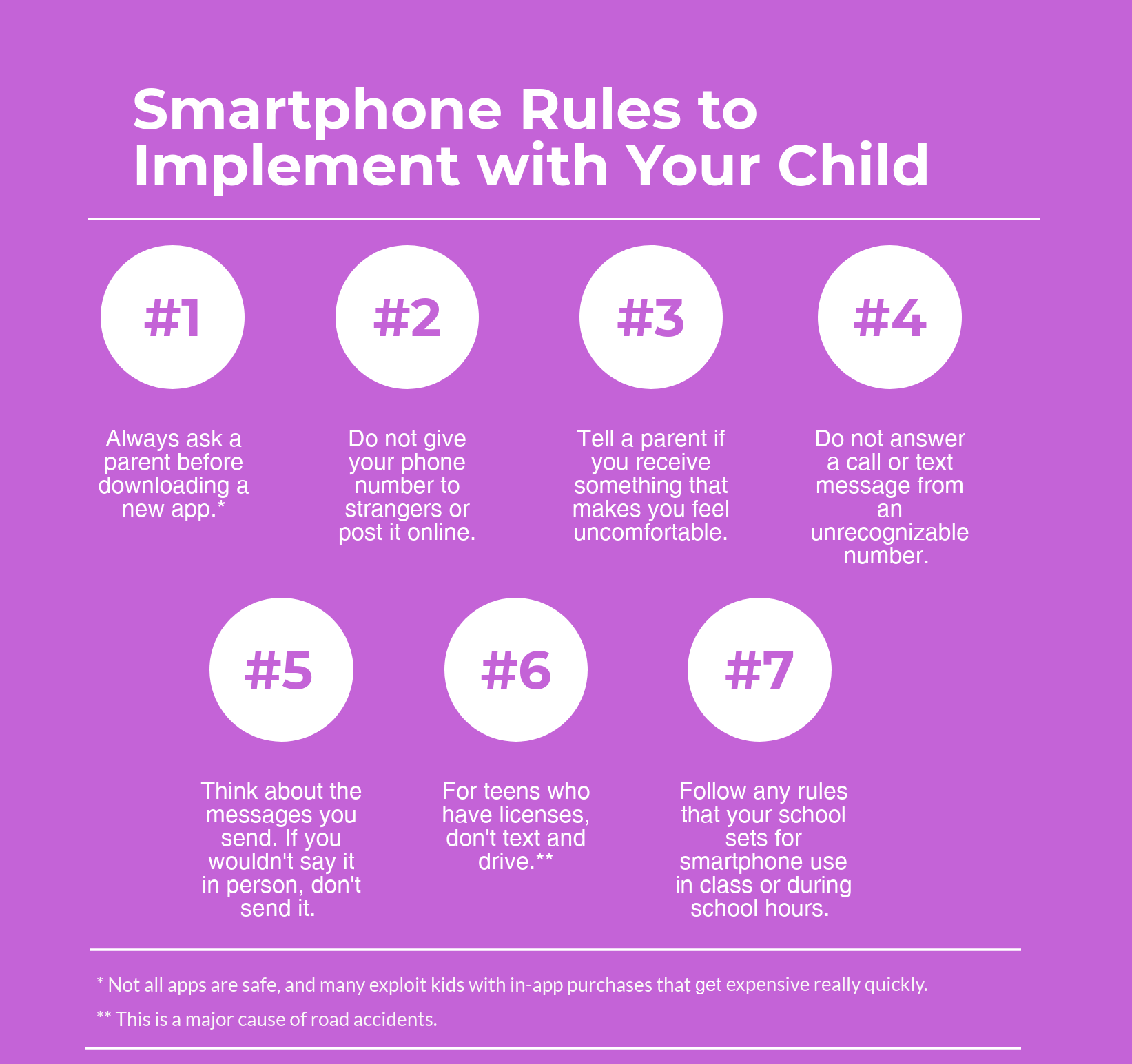
Implement smartphone rules with your child. Making sure your kids involve you on their phone activities with help keep them safe.
There are many precautions you can take to implement phone safety:
  • Have your kid sign a smartphone contract before you give them one. Print out a list of cellphone rules and stick it in a public place in your home.
  • Download parental controls. Parental control apps for younger children enable you to limit your child’s usage, determine their location, and monitor their calls and messages. Apps also allow you to shut off certain functions at different times. For example, disabling text messaging while driving.
  • Set limits when your child can use a smartphone and for how long each day.
  • Set a personal example for your child. Don’t bring your phone to the dinner table, and don’t text and drive.
  • Set up a charging station in a central location in your home. Phones should stay out of your child’s bedroom and they won’t be in use late at night.
  • You can also install an app to monitor your child’s activity. Keepers is one type of app that alerts parents about harmful, abusive, or suspicious messages, and it includes a tracking device to show your kid’s location in real time.

2.  Streaming content and smart TVs

We like to think back to a time when the whole family gathered around the TV to watch something wholesome together. (In reality, many of us probably had a TV in our rooms, and spent many hours watching TV without much guidance from our parents.)
That being said, streaming content has shot up in popularity, and there are more TV shows and movies available at our fingertips than ever before, much of it not particularly appropriate for kids.
There are, however, some great benefits of streaming services. Many feature great, educational children’s programming and documentaries. Most don’t show any ads, meaning that your kids won’t be bombarded with commercial messaging from all sides like they are when they watch regular TV. You can open up an entire world for your children with streaming content – the key is how you use it.
Most of the big streaming content providers have parental controls, some more robust than others. Netflix allows you to set up separate profiles for you and for your children.
Using these tools, you can ensure that your kids only have access to age-appropriate content. Because Netflix’s children’s menu features a different color scheme than the regular menu, you can easily see whether your kids access the content permitted to them or not. However, this doesn’t stop kids from moving over to your profile, so you still have to be vigilant.
iTunes and Apple TV allows parents to set rating levels for the content their children watch. By contrast, Amazon Prime features no parental controls, so the only thing to do is to logout of your account and not share the password.
All of these tools, however, do not replace having frequent conversations with your children about what they watch.
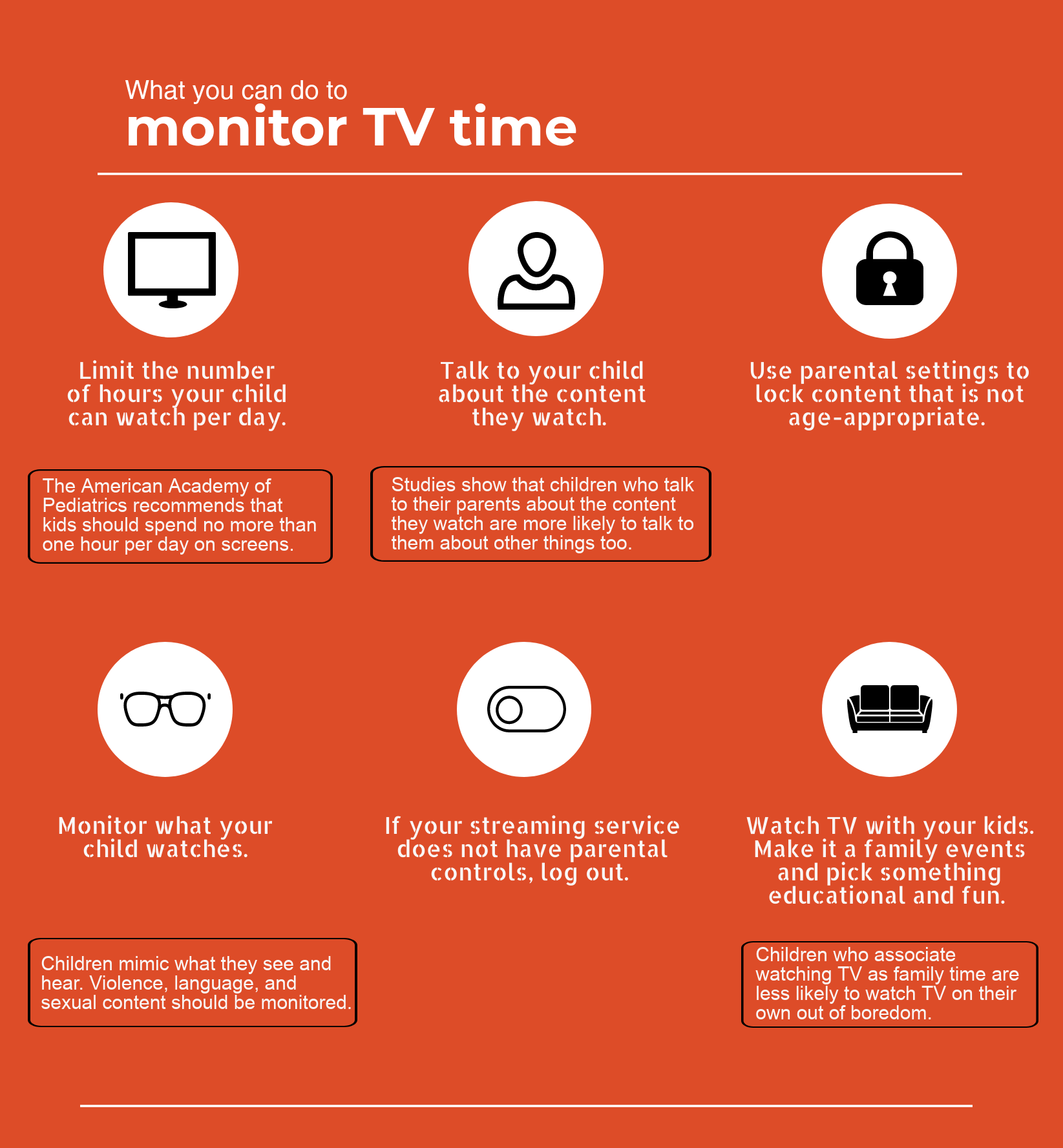
Monitor TV time infographic
Monitor TV time by limiting the number of hours they watch per day, incorporating parental settings, talking to your child about the content they watch, and spending TV time as a family.

3.  Gaming consoles and online games

According to the NPD group, 91% of American children aged two to 17 play video games. Gaming consoles have long been a focus of fear and concern for many parents. With so many games featuring violent or sexual content, it is important to be careful about the kinds of games your children play.
In addition, console games that have a multiplayer component, or games that are entirely based online, are open to abuse from other players. Many games allow players from all over the world to chat with one another, potentially exposing kids to harassment and cyberbullying. Kids may also form relationships with other players and may give away their personal information.
Games are also a great way for kids to develop a variety of skills. They help children develop problem-solving skills, learn how to commit to long-term goals, and how to work as part of a team. They can also be a great opportunity for family bonding. Luckily, most gaming consoles provide robust parental controls, so parents can monitor their children’s gameplay.
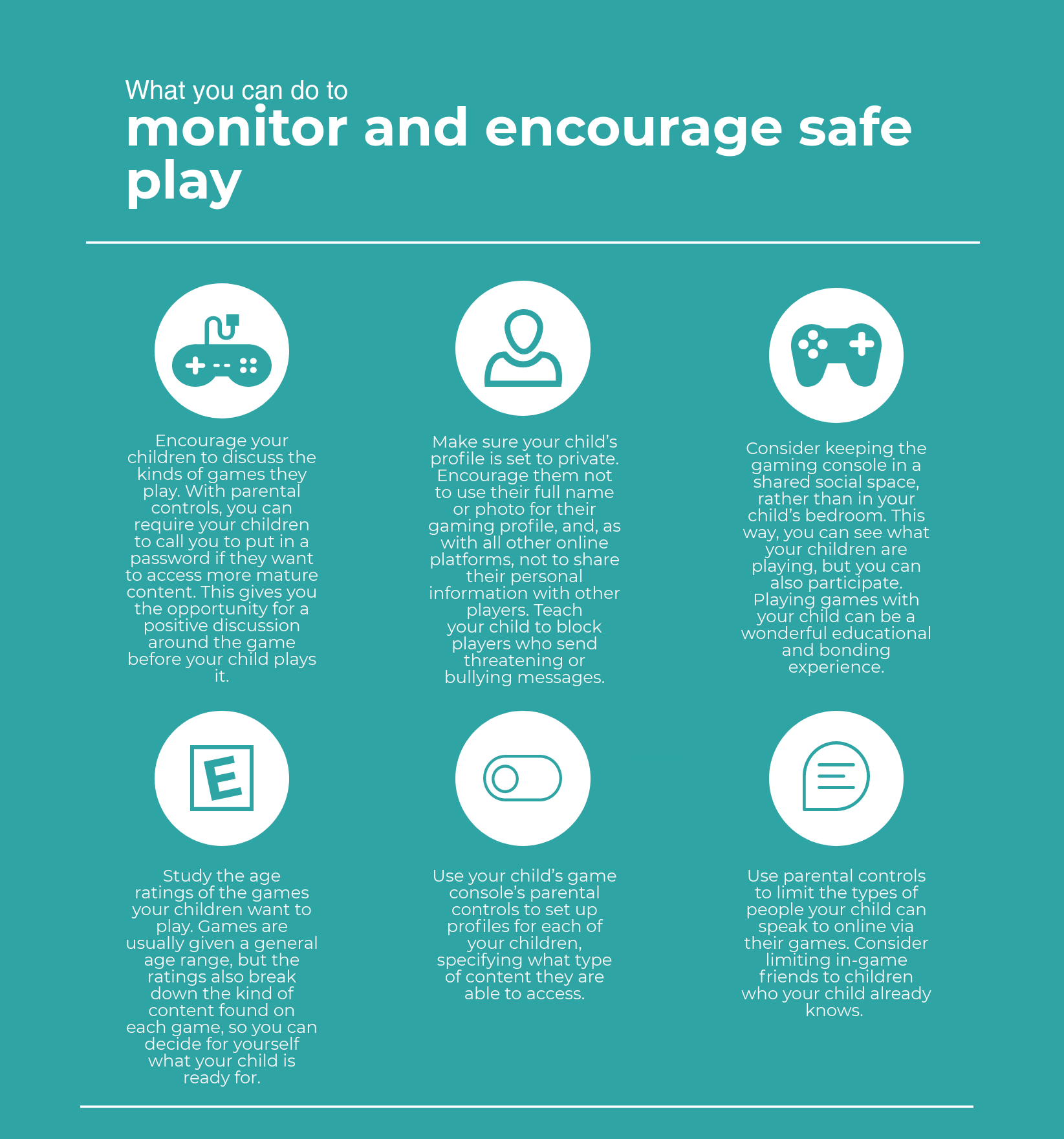
Monitor and encourage safe play infographic
Encourage your children to discuss the games they play. Make sure your child profile is set to private. Consider keeping the gaming console in a shared, social space. Study the age rating of the games. Use parental controls to set up profiles. Limit the type of people your child can speak to online.

4.  Social media

While the format has changed, parents have worried about their kids’ TV shows and video games for years. Social media, on the other hand, is a new worry to add to your plate.
Social media usage is now ubiquitous amongst US teens; 71% use more than one social platform. Children nowadays also spend an enormous amount of time on social media. A survey by the non-profit group Common Sense Media showed that 8 to 12 year-olds were online six hours per day, much of it on social platforms, and 13 to 18 year-olds a whopping nine hours!
According to a recent Harvard study, even though most social media platforms require users to be 13 years of age to sign up, 68% of parents surveyed had helped younger children set up an account.
Social media can be particularly addictive for tweens and teens. It also opens the door to a variety of different issues, like cyberbullying, inappropriate sharing, and talking to strangers (more on those below).
Access to social media is also central to teens’ developing social identity. It’s the way that they connect to their friends, and it can be a healthy way to hang out. The key is to figure out some boundaries so that it remains a positive experience.
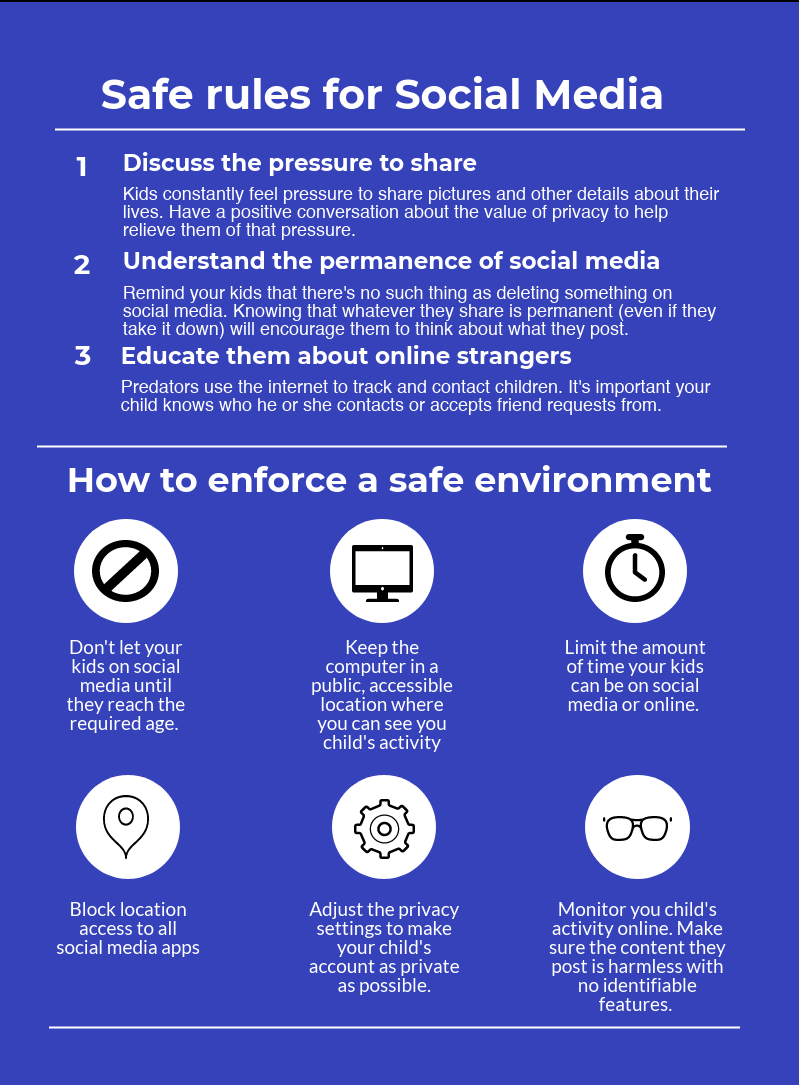
Safe rules for social media infographic
Enforce a safe environment. Do not let your kids on social media until they’re old enough. Keep the computer in a public location. Limit the amount of time spent on social media. Block location access to all apps. Adjust the privacy settings. Monitor your child’s online activity.

5.  Cyberbullying

Our children’s lives have moved online. Unfortunately, their bullies have moved online too.
Cyberbullying is frequently in the news, with reports of teen suicides due to online harassment.
Cyberbullying occurs across all of the platforms we have outlined above, and it comes in many forms: spreading rumors and sending threatening messages via social media, texting, or email, pretending to be another child and posting embarrassing material under their name, forwarding private photos without consent, and generally posting online about another child with the intent to humiliate or degrade them.
Cyberbullying is particularly harmful because it is so public. In the past, if a kid was bullied on the playground, perhaps a few of his peers saw. Now, a child’s most private information can be splashed across the internet and is there permanently unless reported and taken down.
Cyberbullying can negatively affect the online reputation not only of the victim, but also of the perpetrator, and have a deep impact on that child’s future, including college admissions and employment.
It is also extremely persistent. If a child is the target of traditional bullying, his or her home is more often than not a place of refuge. Because digital platforms are constantly available, victims of cyberbullying struggle to find any relief.
It’s often very difficult to tell if your child is being bullied online. It happens online, so parents and teachers are less likely to overhear or notice it. Fewer than half of children bullied online tell their parents or another adult what they are going through, according to internet safety organization i-SAFE. In fact, according to a US government survey, 21% of children aged 12 to 18 have experienced bullying, and an estimated 16% were bullied online.
The best way to prevent cyberbullying or to stop it in its tracks is to be aware of your child’s behavior. A number of warning signs may present themselves.
A child who is bullied may shut down their social media account and open a new one. He or she may begin to avoid social situations, even if they enjoyed being social in the past. Victims (and perpetrators) of cyberbullying often hide their screen or device when other people come into their vicinity and become cagey about what they do online. They may become emotionally distressed or withdrawn.
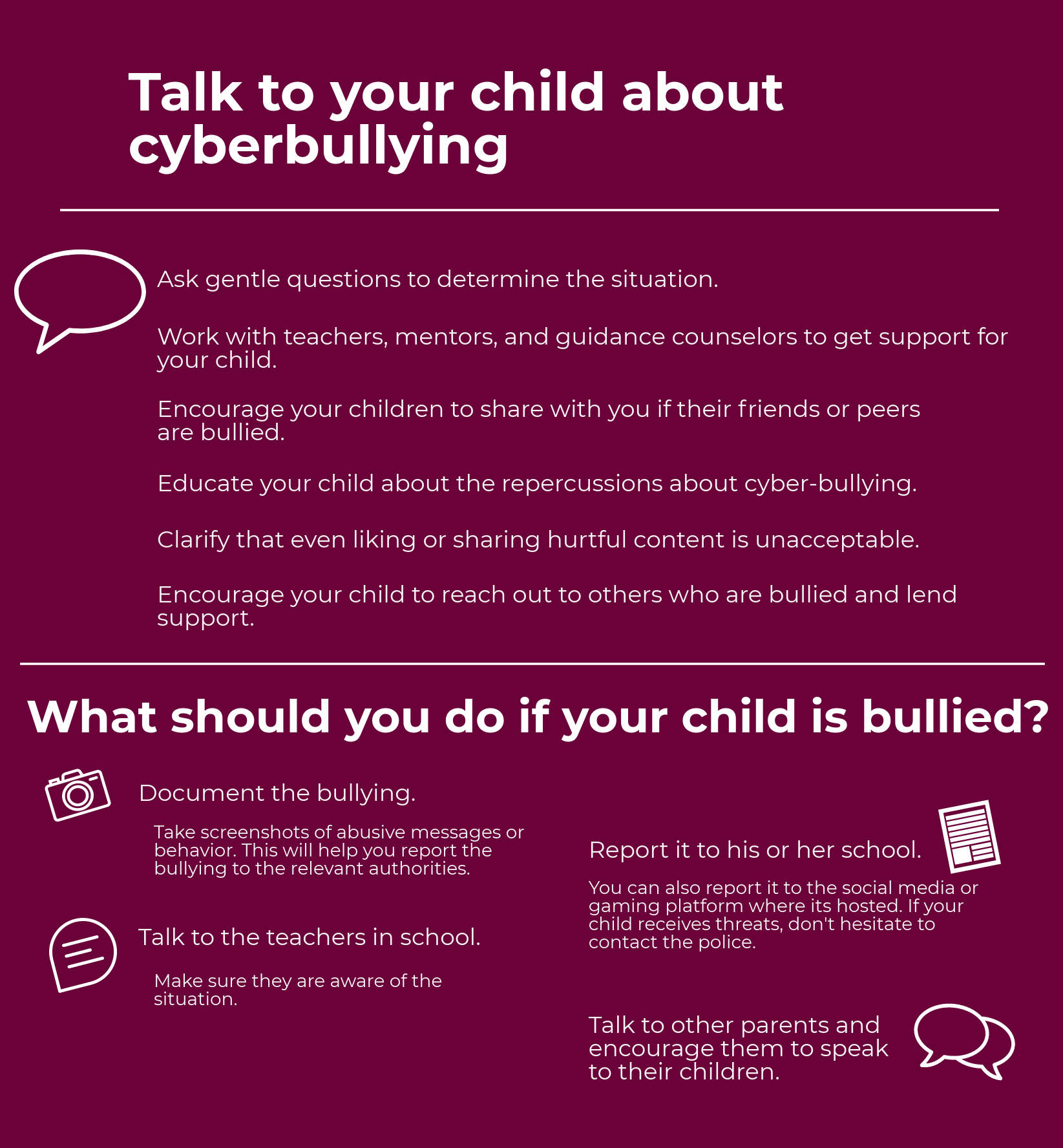
Cyberbullying infographic
Talk to your child about cyberbullying.

6.  Privacy and information security

As parents, we are most concerned about the effect of the online world on our children’s emotional and physical wellbeing. Children are susceptible to information security threats that can cause financial harm. These are the exact same threats that adults face: malware and viruses, phishing scams, and identity theft.
The issue is children are far less experienced and are generally far more trusting than us cynical adults. To kids, sharing their personal details, like their full name or where they live, may not seem like such a big deal. They may even be tricked by a malicious third party into sharing your credit card details.
There are a number of ways that hackers and thieves can get information out of children. Free downloadable games, movies, or even ringtones that market themselves to children can place viruses onto your computer and steal your information.
Hackers posing as legitimate companies like Google send emails purporting to ask for your child’s password. Or, they may pose as one of your children’s friends.
What should you communicate to your child?
  • Have a discussion with your kids about the big threats online today. Make sure they know what a phishing attack and a disreputable games website looks like, so they know not to fall for these scams.
  • Make sure they keep all of their information private and that they never publish their full name, phone number, address, or school they attend in a public place.
  • Talk to your kids about passwords. Having a strong password is the first and best measure to prevent hacking and identity theft. Using a secure password generatorlike the one we created is great for this occasion, and trying out passwords together is a fun way of ensuring your child’s password is as strong as possible.
  • Tell your kids to avoid using public wifi – this is an easy way for hackers to get into their devices.
What you can do to create a safe environment:
  • Install a strong antivirus program on your home computer and the devices of all family members.
  • Think about installing a VPN on your computer. A VPN, or virtual private network, encrypts your connection and anonymizes your web browsing. This makes it far harder for hackers to access and steal your private information.
  • If you and your kids use a lot of different devices around the house, consider installing a VPN on your router. That way, all internet traffic that goes through the router will be protected, without having to install the VPN on every device.
  • Install an ad blocker so your children won’t have to face deceptive advertising that encourages them to download malicious programs onto your computer.
  • If your kids have smartphones, make sure that their security settings are set to maximum.

7.  Viewing inappropriate content online

Because the internet is so open and public, it is also a place where kids can stumble upon content intended for adults, content which they may find upsetting, confusing or distressing. “Inappropriate content” can mean many things to many different people, from swearing to violence to sexual nature.
It’s not easy, but eventually, you will need to have a conversation with your children about what they might see online. Many children don’t go to their parents when they see something they perhaps shouldn’t have seen, for fear that their parents will be angry at them, and take away their devices or internet access.
If your child comes to you with this type of issue, the best thing to do is to respond calmly and be open to discussion. If the content under discussion is sexual, your child will likely be embarrassed already, particularly when talking to their parents about these kinds of issues. Let them know you are there for them and are ready to answer any questions without judgment.
Young people may see sexual content online for all kinds of reasons. They may have seen it by mistake, a friend might have sent it to them, or they may have sought it out themselves out of natural curiosity.
It helps a great deal to talk to your kids honestly and frankly about sex, and a discussion about online pornography is a crucial part. A lot of research has shown that pornography can have a detrimental effect on young people, giving them distorted and unhealthy notions about sex. Pornography can also lead people to think of others as objects, rather than people with thoughts and feelings. At the same time, it’s totally normal to be curious about sex and relationships. This conversation is a great opportunity to direct your kids to positive resources about sexuality.
There are also a number of steps you can take to try to prevent your kids from being exposed to content they’re not ready for, like setting up parental controls on your internet connection. Remember, though, that technical fixes can’t replace open communication with your child.
Communicate with your child:
  • Let your kids know that they can always come to you if something is bothering them, or if they have questions about anything they have seen online.
  • Let them know that it’s totally normal to be curious about sex. Direct them to positive online resources like Brook and Thinkuknow. Thinkuknow is particularly good for younger children, and it includes different, age-appropriate sites for different age groups. You may find it helpful to look through the site together and discuss some of the issues.
Steps you can take to block inappropriate content:
  • Set filters to block inappropriate content like pornography. Your ISP (internet service provider) should provide free parental controls, as should most gaming consoles. These are usually pretty easy to set up.
  • Set Google to “safe” mode so that your children won’t inadvertently see inappropriate content in search results.
  • Install an ad blocker to prevent viruses that might have inappropriate content.

8.  Online predators

In our last section, we take a look at the darkest and scariest online threat of all: online child predators. According to the US Department of Justice, 13% of young people with internet access have been the victims of unwanted sexual advances, and one in 25 children have been solicited for offline contact.
Predators engage in a practice called “grooming”. In other words, they attempt to form a relationship with a child with the intention of latter abusing them.
The internet has made life a lot easier for child predators. Predators target their victims through any and all online mediums: social media, email, text messages, and more. By far the most common method, however, is via an online chatroom: 76% of online encounters with sexual predators begin in a chat room.
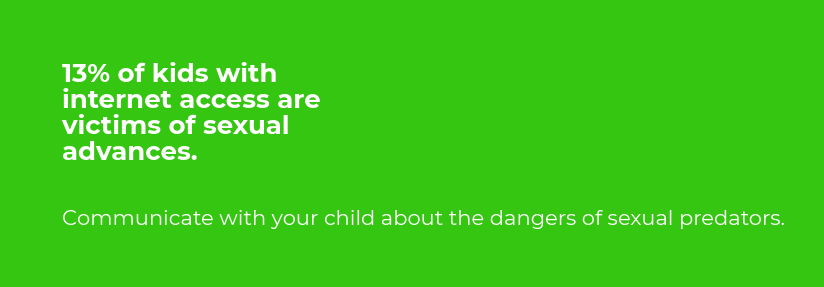
13% of kids with internet access are victims of sexual advances
Predators often create multiple online identities, posing as children to trick kids into talking to them. They discover as much as they can about the children they are targeting by researching those children through their social media profiles, and what they have posted on chatrooms.
They may contact a number of children at once but tend to concentrate their efforts on the most vulnerable. These predators aren’t satisfied with merely chatting with children online. They frequently trick or coerce their victims into online sexual activity, via webcam or by sending sexual images. They may also attempt to meet and abuse their victims in person.
It’s not always easy to tell if a child is being groomed, particularly because most keep it a secret from their parents. There are a number of warning signs: children who are being groomed by predators may become very secretive because the predator often threatens the child not to share information with their parents or friends. Children can also become sad and withdrawn, distracted, and have sudden mood swings. It is absolutely crucial to let your child know that you are there for them and that they can talk to you about anything.
What should you communicate to your child?
  • Have a discussion with your child about the risks of online predators. Make sure they know to be careful about who they talk to online, and not to share any personal information with strangers.
  • Tell your kids that they can come to you with any problem, no matter what it is.
  • Think about working through some educational content with your children relating to this topic, like the excellent videos at Thinkuknow.
  • If you think that your child is at risk, seek support from their school, a social worker, and the police.

Conclusion

There are lots of different technical tools available out there to help keep your kids safe online. These vary from VPNs and antivirus software to internet filters and parental controls. But none of these are really enough to help keep your child safe.
As we’ve repeated over and over in this guide, the key isn’t mastering a set of complicated technical tools. (In fact, most are very easy to set up, so don’t let a lack of technical ability hold you back). It also doesn’t mean you have to master the latest internet fad every time one pops up – believe us, you will never keep up!
The far more important, but also far more difficult task, is to have frequent, open and honest discussions with your children about their lives. Remember, internet companies, social media networks, gaming providers, and everyone else in the online space may be able to help you set content limits, but they don’t necessarily have your child’s best interests at heart.
The very best person to keep your child safe online is you. Talking about how to stay safe on the internet is an excellent conduit to build a trusting and positive relationship with your child.
Internet safety needs to be a priority for every parent and caregiver. If you have found this guide useful, consider sharing it with friends and family via Facebook and Twitter.

Feel free to share and copy this post or parts of it to your site, blog, or social networks. All we ask is that you attribute it to us. We want to keep kids safe, and your help to spread the word is important.

Click here to share it on Facebook or Twitter.