Sunday, September 4, 2016

Russian Min. of Ed

MISUNDERSTOOD MINISTER  OR PHILISTINE?By Stephen Wilson


Russian Min. of Education Olga Vasilieva

Moscow, Russia --  The new Minister of Education got off to a bumbling start with an inarticulate public statement raising a barrage of  questions about her level of Russian.

               When the new Minster of Education, Olga Vasilieva was asked by a journalist, "How do you see your appointment? What emotions did you experience?", she replied: "Concerning emotions - it was an unexpected divine calling, if you understand this. A calling concerning what you must do (irrespective of your will. " The Russian version of the answer goes : "В отношении  змоций божествование , если понимаете Божествование того, что Ты делаешь".

               When I first heard this statement I was stumped . The word 'boshestvovaniyi' confounded and bemused not only me but Russian journalists.

               Being a meticulous student of Russian I thought : "Great! A new expression to add to my notebook. I looked up my Russian dictionaries and asked around.

               My search was in vain! Maybe it was important to purchase a new dictionary!

               I later discovered that the reason I could not find such a word is that no such word existed in Russian. A Russian told me: "This new Minister of Education simply does not know Russian. It is not news . We always have ministers like this. Just look at the face of the New Minister of Education. It reminds you of an old authoritarian Soviet school director. A person without any real culture or literacy. This is not news for us."

               Funnily enough, the statement did not appear to merit even a scandal but just mild amusement from bloggers who regard her as an illiterate philistine. Attempting to correct the blunder, the Minister of Education stated: " I never said or meant this word. You journalists don't understand me and have misconstrued my statement . What I really meant was my appointment was a moral or spiritual position (dolzhestvovaniyi)           (Должествование) .

               The second statement was equally baffling! Again such a word does not exist in the Russian language! The second statement  only succeeded in reinforcing the first impression . So what you have is the Head of Education
does not really know Russian.... Or perhaps she is attempting to reinvent the Russian language or test its limits. In her defence you might claim that there is a wide discrepancy between the prescribed language defined
by teachers, professors and linguists and the actual  language people speak  on the streets which violates grammar rules and that her opponents are just intellectual snobs!  However, teachers of Russian in schools are often unforgiving perfectionists who expect better from a Minister. I mean it is not as if she is a trader at the market but is the Minister of Education who has to serve as an example to school students! If I was in her  shoes I would reply that I was experimenting with the language and trying to do a James Joyce. I might also reasonably claim that the poet  Pushkin made grammar mistakes in his Russian and had an editor! This editor turned out to be Nicolas the first! Unfortunately,
the Minister of Education is not Pushkin and does not have an editor like Nicholas the First. So Russian teachers  might not  be so forgiving! But she is already the butt  of  jokes. 'She wants our prayers not our votes ', declared one blogger.

               When Aleksi Venediktov, a famous journalist  learnt of her appointment , he immediately resigned from a social advisory body on education. He objects to her strong conservative Orthodox religious views. However, other people are not so anxious about her Russian or her religion but  views on Stalin and her rumored intolerance of other points of view.

               That is not the impression one attains from listening  to some  of her other public statements. For instance she has stated:

               "It is imperative to ponder, and analyse everything, that has happened , because those reforms which have been accepted, they demand deep thinking.

               We must take everything of the best: from the 19th century, from the 20th century and the 21st century." (statement to Kommerant FM)  and "I like the thought arising from a phrase of Einstein. It is clear that he had a complex enough attitude to education. He said ,that schools must
prepare harmonious personalities , and not narrow specialists."

               She is also on record  for warning parents not to push their children too hard in preparing for the Unitary state exams. It is evident she is aware of how many children are becoming stressed out over those exams . Parents can
easily forget that children should be allowed to be children. They need time to just play.

               However, most teachers are doubtful  whether the new Minister of Education will make much difference. The Ministry of Education has on many occasions promised to increase wages and cut the huge amount of red tape ensnaring teachers. According to Andrei Demidov, of the union, 'Teacher', the best they can expect from the new Minister of Education is to 'leave teachers alone' and put off  the on-going reforms in education. This is because 15 years of constant change has exhausted teachers. He stated: "School education really  requires peace and quiet. A pause in the reform of of the past 10-15 years, as was written by participants in a survey organised by the union Teacher in 2015.

               We would like to get used to all those changes! (see Novaya Gazeta, number  95, 29.08.2016, 'Оставьте Учителя в Покое', Андрей  Демидов.)

               This is an unlikely possibility if we take at face value the latest statements by the Minster of Education. Concerning the Unitary State Exam, she has stated: 'But I think that it is all the same, and we need to perfect those       exams.'  It looks like teachers won't be left in peace!

Friday, September 2, 2016

CPS Response

The Position of the Chicago Board of Education
By Jim Vail


The Chicago Board of Education is preparing itself for an eventual Chicago Teachers Union strike this fall.

The most important part is their public position for why the budget is what it is and teacher cuts are inevitable.

First, the budget today is based on major cuts - pension reform and teacher cuts where the Chicago Public Schools no longer pay the teachers' 7% pension pickup. That's 7% every year, which saves the board a lot of money.

The mayor who picks the board members who vote for him does not want the banks, corporations or extra slush-fund Tax Increment Financing (TIF) funds to pay into the education budget.

CPS CEO Forrest Claypool said in his letter on the budget that is posted on the website that because of the pension payments the board was not able to hire 4,000 or so teachers.

So the pensions have to be cut so more teachers can be hired and class sizes don't balloon.

The surplus TIF funds of $300 million or so that would plug the deficit and not mandate cuts on the schools and teachers is only temporary, and therefore not realistic. Whatever that means.

This message rings loud and clear in the corporate media. 

Substance News editor George Schmidt reports that the network offices that police the schools have doubled the number of staff during this so-called crisis that demands cutting teaching staff.

The budget is opaque that former Catalyst report Sarah Karp said it's impossible to read.

So do you believe CPS that they can't pay the teachers and fully fund the schools?

Friday, August 26, 2016

Book Review on Gangs

Book Looks at Attempt to Build Hispanic Mafia
By Jim Vail
Special to Mychinews.com


The Insane Chicago Way is the untold story of a plan to create a Hispanic mafia in the 1990s and why it failed.

The book is written by criminologist and UIC professor John Hagedorn who has been studying gangs in this city for more than twenty years and what he reports is an eye opener for anyone interested in how the city’s black market economy operates.

Hagedorn focuses on a white working-class gang called the C-Note$ who were interested in working with the Hispanic gangs to create an organized crime operation in order to limit violence and increase profits. Hot tempers and burning Latino emotions eventually doomed the attempt to mirror the Italians and Al Capone who consolidated the gangs in the 1920s and worked with the police and government to insure a multi-billion dollar organized criminal operation that would continue for the next 100 years.

The book centers on the secret history of Spanish Growth & Development (SGD) – an organization of Latino gangs founded in 1989 and modeled on the Mafia’s nationwide Commission. The C-Note$, considered a minor league team of the Chicago mafia (called the Outfit), influenced the direction of SGD. 

Hagedorn’s tale is based on three years of interviews with an Outfit soldier as well as access to SGD’s constitution and other secret documents, which he supplements with interviews of key SGD leaders, court records and newspaper accounts.

As you get into the book your head will start spinning with the number of gangs and affiliations and families that divide the city from Northside to Southside, People and Folks and neighborhoods. The history of gangs includes the Puerto Ricans who were pushed all around the Northside who formed them to protect themselves from the whites, and the blacks who some called themselves Vice Lords to take control of the drug market from their white overlords, so that now they are lords of vice.

The one problem Hagedorn has is his entire tale about SGD is based upon an insider who for obvious reasons does not want to give his name. As journalists we are loath to quote sources off the record, but at times it is necessary. There would be no story otherwise. However, this has been used by government and others to plant suspect stories in the media to fight rivals. But what “Sal” tells in this story to the author crosschecks with a lot of Hagedorn’s contacts and research, and certainly fact is a lot more fun than fiction. This is the real nasty world of gangs, drug money, dirty cops and government officials who all work together to ensure the profits continue despite the violence.

Hagedorn said one problem with traditional gang researchers is that they do not make the connection that Chicago gangs built complex, secret structures to regulate violence, organize crime, and buy off police and politicians. The professor attended a conference on gangs and not one “gang expert” mentioned the role the cops and corruption play with gangs. I wrote a previous article in this paper how the gangs help elect aldermen today. To ignore this is to ignore reality.

The beginning of the book explains how SGD was formed by seventeen “Latin Folks” gangs in 1989 and was dedicated to curtailing violence and organizing the drug trade. To begin, one has to understand that the gang life here in this city is central to our history and who we are. Former Mayor Richard Daley the First who ruled this city for over 25 years and some said had more power than President Kennedy was an Irish gang banger. Now you follow me?

“Well, it started out as turf gangs,” Sal tells the author. “You know, where you had the Irish on one side, the Italians on one side, Germans and the Puerto Ricans and the Mexicans and the blacks. And they basically fought, you know; you stay on your side of the street and we stay on our side of the street. And that was for years through the tumultuous sixties, through the seventies. But once the late seventies, early eighties came, uh, the game changed when narcotics were introduced at a high rate. And some of these organizations went from turf gangs and they evolved into more structured criminal enterprises.”

The key here is gangs who run criminal operations and want to be successful have to do what the Kennedys and others have done, assimilate into conventional society and become respectable. I myself as a journalist saw the transformation of the mafia in Russia in the 1990s where thick necked thugs in track suits transformed into Armani suits carrying briefcases mixing in luxury hotels to today’s businessmen and parliamentarians. Sal says: “And the Hispanics are doing that. They’re opening restaurants; they’re opening up grocery stores. They’re taking their money and turning it over. So sooner or later, they no longer have to do the illegal stuff and the legit stuff is taking them over.”

It was gangbangers seeking safety behind prison bars that led to forming the SGD. “Spanish Growth and Development was an attempt to try to get everybody on the same page. To try to get power and become a part of the Machine.”

The book starts with describing a hit, a drive by and who got killed. What the TV news people can never tell us is why did a 16-year-old get shot and killed. Drugs? Gangs? This book will tell you the details about why exactly young people shoot other young people on our streets almost every day. The hit involved a Latin gang called the Latin Lovers on the Maniac Latin Disciples (MLD), who had connections to Mexican drug cartels and saw its power on the streets grow considerably, allowing them to exact a street tax on smaller gangs buying their product, and attract young kids who flocked to the biggest and baddest gang in the hood. A violent power struggle erupted between MLD and the Spanish Cobras, who both were recruiting fellow gangs to join their factions, called “families.” They both joined SGD, whose top leaders were incarcerated in prison, or the “White House,” and that is where major decisions were made. “Killing people and doing drive-by shootings is bad for business. All it does is bring the attention of law enforcement. When law enforcement has all eyes on you, no one can make any money,” Sal says.

The major player behind SGD was the C-Note$, a mostly Italian group of working class guys who were successful because they were smarter, integrated into society working union jobs, and had family and friends on the police force or attorneys who would help them out. They started to integrate Latinos into the top leadership when they saw the explosive growth of the Hispanic population in this city who now almost outnumber the whites and blacks combined. One story I found almost unbelievable. Sal says the C-Note$ cleaned out Bill Daley’s house when the mayor’s brother was at his confirmation hearing to be commerce secretary in Washington after Obama was elected.

The history of gangs in the 1960s is a contested narrative, according to Hagedorn. “The increase in African American and Puerto Rican population in the 1960s shook Chicago politically. It has racialized gang identity, as whites defended their turf against nonwhites, as well as blacks, and Latinos affirmed their own racial and ethnic identity in the face of racist violence. This violence coincided with deindustrialization that in turn led to unprecedented  increases in concentrated poverty, particularly among African Americans. These desperate conditions led inevitably to the expansion of the illegal economy. Hypersegregated neighborhoods of the black poor, which had shaken loose of black politics by the white Daley machine, made it impossible for the Italian Outfit to keep control of retail drug sales and vice markets for the new street gangs.”

A mafia elder called the Don told the author, “Without the cops, none of this stuff could happen.”

Which leads to the next important step to understanding how the narcotics market continues to flourish in Chicago despite the so-called war on drugs. Enter the Chicago Police Department and their key role to keeping the drugs flowing, on the sly, or openly in some cases.

Latin Folks gangs learned from the Outfit (Mafia) the importance of police corruption to protect their business. “And cops didn’t come as cheap as politicians.” As stated earlier, traditional gang research almost has nothing to say about police corruption, who criminologists define as being on the side of social control, while corrupt cops, if they are mentioned at all, are “bad apples.” 

Those on the inside know the cops play a key role here, some referring to our men and women in blue who are here “To Serve and Collect.” Police corruption has always been strongly related to organized crime. The difference, Hagedorn writes, is the Italian Mafia focused on the highest levels of the Chicago police, while today’s street gangs work with the lower rung of the force. Race certainly plays a role.

The stories of top corrupt Chicago police officials are stunning. William Hanhardt, the Chicago Police Department’s (CPD) chief of detectives and deputy superintendent in the 1980s, was convicted in 2001 of running a jewel ring for the Outfit that stole more than $5 million in diamonds and other gems. Hanhardt used CPD computers to get information on jewel traders to set up his burglary operations, protected and run by police.

Then there is Chicago’s police commissioner Matt Rodriguez, who was forced to resign in 1997 for his ties to Mafia figure Frank Milito, who happened to also be a deputy sheriff who owned gas stations and restaurants. The two vacationed together in Italy, Israel, California, NY and the Bahamas. Milito encouraged Rodriguez to protect Pierre Zonis, a Chicago police officer who was being investigated as a hit man for the mob in multiple murders. Those hits included killing oil company executive Charles Merriam whose uncle and grandfather were both famous anti-machine reformers. Merriam took away Milito’s gas station franchise after he was convicted of tax fraud, and Milito was suspected of paying Officer Zonis to do the hit. Rodriguez squashed the investigation of Zonis.

But more important than these high-profile cases is the fact that being a police officer and told to arrest anyone consuming or selling a product that is visible on almost every street corner and consumed by so many of us is impossible. 

“From the police officers’ point of view, it is impossible to do their jobs without making deals with one enemy in order to get another. There are so many drug transactions going on that arresting everyone is impossible. Good police work in the war on drugs means discretion, and discretion means police officers are always making decisions on who to arrest, who to make a deal with, and who to leave alone for a time. This means difficult decisions for honest officers and golden opportunities for corrupt ones.


This book takes such a fascinating look at the underworld that is connected to our legal cash economy that I have decided to make this book review the first part in a series. Look for my second part that will get into more of the specifics of which gangs are fighting on your streets.     

Wednesday, August 24, 2016

Watch Me!

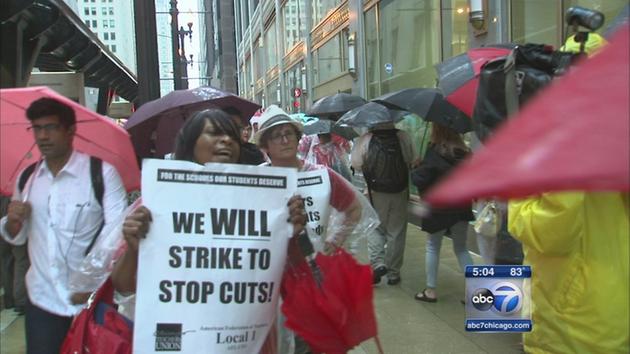
CHICAGO TEACHERS PROTEST $5.4 BILLION CPS BUDGET

EMBED </>MORE NEWS VIDEOS 
Chicago Teachers Union members marched in the rain as the CPS board voted on the district's budget. (WLS)
The Chicago Public Schools board unanimously approved Wednesday a $5.4 billion budget for the district which is expected to increase Chicago property taxes.

The fiscal year 2017 budget is contingent on several factors, including $200 million from the state, which must pass pension reform by January, and on $30 million in concessions from the Chicago Teachers Union, which members are not happy about.

Gov. Bruce Rauner said he would "try my darndest" to get pension reform done by January. And CTU concessions are also uncertain.

In fact, CTU said they will likely strike in mid-October if they don't get a new contract. The union's leadership and delegates will hold a phone meeting on Thursday.

Undeterred by Wednesday morning's rain, Chicago teachers marched on the sidewalk in front of CPS headquarters chanting, "They say cut back. We say fight back!"

"We're very concerned. A lot of positions, especially for special education. There were vacancies before this school year started and they closed those vacancies," said Maria Moreno, CTU financial secretary.

This year's CPS budget is bigger than last year. But CTU said it's still not enough money - specifically for special education students.

Many teachers and parents spoke out during the meeting, concerned about fewer teachers and expanding access to pre-kindergarten services.

"We're seeing CPS shuffle money from pre-K education to K-12 education, instead of using those dollars as intended," said Brynn Seibert, Service Employees International Union.

CPS spokeswoman Emily Bitner said there are more teacher job vacancies than layoffs. CPS still has 700 openings they are looking to fill for this school year.

Teachers said they will work on Sept. 6, the first day of school for CPS. But teachers also said they aren't afraid to strike to avoid cuts.

"It's going be a cut in salary. Teachers don't get social security, so it's their retirement - what they expect after working many years," Moreno said.

CPS CEO Forrest Claypool thanked taxpayers for shouldering the burden of another property tax increase. He also said he hopes a strike will not dampen the CPS community's spirit, especially at the beginning of the school year.

"Our hope now is to reach a final agreement with the CTU so that once school begins our children can remain in the classroom where they belong," Claypool said.

The Civic Federation called the CPS budget "out of balance" because of the uncertain funding.

Tuesday, August 23, 2016

Budget hearings

Chicago Public Schools Hold Budget Hearings
By Jim Vail
Special to Mychinews.com


CTU organizer Marty Ritter
People spoke out at the Chicago Public Schools budget hearings last week after 1,000 teachers and teacher aides were recently fired.

“Most teachers who came here are here because they lost their jobs,” said Chicago Teachers Union organizer Martin Ritter. “Every school has lost teachers. New schools are great, but there are hundreds of schools that need extra resources.”

The CPS budgeting team spoke to a room of about 75 people at the National Teachers Academy on Wednesday, Aug. 17, to lay out a $300 million capital budget plan to renovate and build new schools.

Activists have pointed out that CPS has been building new schools while enrollment has been dropping.

Ritter said CPS should endorse a couple of proposed ordinances for progressive revenue that would include funneling the surplus of tax increment financing funds and increasing the employee “head tax” and personal property lease tax to generate additional school funding.

CPS responded that they have looked at state funding, but that all sources of revenue should be explored.

The mayor has so far made no effort to support these measures nor has he asked the banks that have profited off toxic loan swaps at the schools’ expense to reimburse the city. Other cities such as Jefferson, Alabama have successfully sued the banks to recover money lost to toxic loans.

In addition to borrowing $725 million at a whopping 8.5 percent that will further indebt the city, the Chicago Board of Education proposed the sale of up to $950 million in bonds to pay for construction projects to support capital improvements and other expenses at 7.25 percent interest.

Bond holders and banks continue to profit at the schools’ expense.

Rather than build new schools or additions to relieve overcrowding, CPS can make boundary changes to save money and preserve teachers and minimize class sizes, said Sarah Hainds, a CTU researcher.

“Now we have many schools that are underutilized because of all these charter schools,” she said.

CPS continues to make proposals for more charter schools despite the costs and opposition.

Jennifer Biggs from Raise Your Hand said to release the TIF funds and to not build a proposed new Obama Prep school that would save $60 million.
“Chicago does not need another high school,” she said.

Alderman Pat Dowell from the Southside said she agreed that CPS should build a new annex to relieve the overcrowded South Loop school and that CPS should find new revenue for the schools. She did not state if she was in favor of releasing the TIF surplus funds.

Rod Estvan, an analyst with Access Living which advocates for disabled students, said the increased Americans with Disabilities (ADA) funding of $500,000 would maybe fund a new bathroom or some water fountains, but not what is necessary. He said under the Daley administration the ADA funded millions over five years to support students with disability.

Another speaker said CPS should build more athletic facilities such as one stadium each year to promote athletics as an alternative to violence.

A substitute teacher who said she worked as a gym teacher, said she noticed there are fewer teachers, including some classes with no regular teacher. Why, she asked, does the funding not address hiring more and not less teachers.

CPS responded that the capital funding is earmarked only for building and not for hiring teachers.

Monday, August 22, 2016

Education Minister Resigns

RUSSIAN MINISTER OF EDUCATION RESIGNSBy Stephen Wilson

Fired Russian Education Minister Dimitry Livanov

Moscow, Russia --  Dmitri Livanov, the Russian Minister of Education  since 2012, has recently resigned, and been replaced by a teacher, and historian, Olga Vasilieva.

              Many observers presume he was pressurized to resign. If so, he is not the only victim of a government reshuffle. An old comrade , Sergei Ivanov, has also been dismissed from his post in the wake of an imminent Presidental election. This conveys the impression that the government seems to be edgy and anxious about the unpopularity of many Duma ministers.

              In some circles, Livanov was unpopular and even a scapegoat for often unwanted reforms in education.

              Livanov had a daunting job! In recent months Livanov, along with Medvedev, had come under fire for failing to increase teachers pay under the May 2012 accord. By 2015, teachers's salaries were lower than the promised amounts in 17 regions throughout Russia while the workload of teachers had often doubled.

              The attempts to close down poor quality institutions of education was often handled in a haphazard, and chaotic way  that even the existence of high-quality universities came under threat !  Livanov was also accused of attempting to close down the Russian Academy of Sciences and 100 scientists signed a petition of protest demanding " the end of this thoughtless reform of the Russian Academy of Sciences". However, perhaps the greatest scandal to have threatened Livanov was when someone leaked the exam questions in Russian literature openly publishing them on the Internet. Nevertheless, after this scandal, Livanov introduced  draconian measures of surveillance to prevent any potential cheating including the banning of mobile phones, classroom
surveillance cameras and an increase of strict observers.  What amazes many people is how Livanov happened to keep his job after this scandal.

               To be fair, Livanov did not have the easiest of jobs. Practically every problem arising in education was thrown on to his shoulders. He was a convenient punch ball as well as  scapegoat!

               Some people credit  Livanov with achievements. Firstly, he managed to introduce standardised school history books (Common Core in US), took steps to improve the fairness of the Unitary State Exams and attempted to address thorny issues such as whether new topics should be introduced into the school curriculum such as teaching the Orthodox religion. Other ministers would not have dared touch such questions and simply brushed them aside.


New Russian Education Minister Olga Vasilieva

               However, the new minister, Olga Vasilieva, raises some questions. She is not only a teacher, but a historian who wrote a curious paper titled: 'The Soviet Government and Patriotic activity of the Orthodox church during the years of The Great Patriotic war.' Vasilieva herself states that although historians have to strive for objectivity, it is almost impossible. Few people would disagree with this statement.  They might well take issue with whether Stalin himself
revived the Orthodox church during the war and a new ideological interpretation of Russian history where the role of the Orthodox church is idealised .

                In recent interviews, Vasilieva has reassured people she has no intentions of imposing her views of history, or Orthodoxy, on the school system.

                So why was Vasiliev appointed?  Because her Orthodox views appeal to the Partriarchy and conservative members of the Orthodox church and might reverse the poor image of the Russian Ministry of Education. It is important to stress that the Orthodox church remains a powerful lobby in Russian politics and its conservative wing are amongst the staunchest supporters of President Putin. So the appointment may represent an attempt to appease such a lobby who are striving to extend their influence in all areas of Russian life.

                The firing is also an attempt to cool down  the anger of Russians. Dismissing incompetent ministers is a way of taking the heat off Putin and Medvedev. 

                Not long ago the Prime Minister Medvedev made an insensitive gaffe on how teachers should stop complaining about pay and become businessmen.

                But instead of Medvedev being fired, Livanov lost his job!

               It is very unclear what, if any new steps, the new Minister of Education intends to make in education. All the recent statements to the press are generally vague         statements about the importance of teaching as a vocation and the role of education in bringing up children. She even refused to disclose her city of birth for inexplicable reasons!  Being religious, she put down her appointment to God's will!

Russians Bomb Syrians

UNLEARNT LESSONS: MASS INDISCRIMINATE BOMBING IS KILLING INNOCENT CIVILIANS IN SYRIABy Stephen Wilson


Moscow, Russia -- In recent days there has been a massive outcry and anger at the latest Russian -Syrian bombardment of Aleppo in Syria, which has led to the needless death of civilians . The prominent photo of a rescued shell-shocked young boy covered with gray ash from rubble provoked much anger and annoyance. However, indignant protests have hardly altered or stopped the bombing. The French are currently bombing Syrian again !

              WAVE OF PROTEST

              Humanitarian organisations and human rights groups claim that the Russian bombing campaign has not only been ineffective but hindered their efforts by creating more untold suffering of civilians , rather than less.

              The Russian military have been fighting in Syria since 30 September 2015 until  present,  in an attempt to bolster the fragile government of Assad as well remind the World they are still a power to be reckoned with on the
World stage. The war also  serves to strengthen patriotic sentiment as a means  to divert attention from Russia's rising social problems. It is largely about preserving the power and  prestige of the Russian state than  effectively fighting 'terrrorism'. And alot of odd people express support for this war. I heard that an Orthodox priest was cheerfully informing  his congregation that the Syrian campaign : " has made Russia a great power again. Now the west taking account of us."  Actually this rhetoric is more extreme than President Putin. President Putin is on record as having declared that: "Russia is not a superpower ... America is the only Superpower."

               Constant  Russian media reports on television applaud the bombing campaign, claiming terrorists of the Government of Islam have either been killed, or forced to flee.  There is a photo which  shows a pilot painting on one of his bombs : "For Paris".

               But how effective is this bombing campaign ? Can anyone really justify its largely unsystematic and indiscriminate nature? Perhaps  the harshest criticism comes from the Syrian Network of Human Rights. They claim that
Russian forces have killed more civilians than ISIS . They accuse Russian forces of killing no less than 2704 civilians, including 746 children and 514 women, since 30 September  2015. Amongst the victims were 28 medics, including 8 women.

               The Russian Ministry of Defence denied those accusations  stating:

               "Russian forces do not make strikes against targets  inside  inhabited areas". The humanitarian group, Physicians for Human rights , a New York based advocacy group  thunders back:

               'Nothing could be further from the truth. Since launching its military campaign  in support of the Syrian forces, Russian aircraft have hit numerous civilian targets, including well  over a dozen identifiable hospitals killing and injuring scores of people... We know that Syrian and Russian
forces are responsible for more than 90% of the 373 strikes on hospitals and medical facilities'. When those groups appeal to the Americans to do something to relieve the suffering civilians trapped in Aleppo, the standard response is : "we are working on it ". Actually, they, along with their European partners, have also been indisciminately bombing Syria.

               For Americans to condemn Russia for indiscriminate bombing is like the kettle calling the pot black !

               UNLEARNT LESSONS

               It is odd that governments learn nothing from history books. Since the Spanish Civil war, aerial bombing has been largely ineffective. It was not the Germans who invented mass air raids on cities but the British. 

               Neither the Blitz of London nor the subsequent mass bombing of German cities helped the Allied efforts to defeat the Germans. In fact, it hindered it. Britain was saved by fighter planes such as Hurricanes and Spitfires, not bombers. The English historian A.J. P. Taylor stated :
              'The Germans were answered and defeated not by British bombing, but by Fighter command, which had been despised and comparatively neglected before the war. When the British in turn went over to the bombing of Germany, this did more harm to themselves than to the Germans - that is,
it used up more British men and materials than it destroyed German. No one could grasp this before the event, as many in deed failed to grasp it afterwards. ' (See The Origins of the Second world war, Penguin, A.J.P. Taylor)

               Unfortunately, few people still grasp this simple lesson now.

               So why do governments still resort to counter- productive strategies ?

               Maybe part of the reason lies in an uncritical affirmation of new technology.

               Very few people actually ask themselves whether a new machine or invention is needed or really progressive. People overestimate the accuracy  of new improved sights in bombers. The mass media is always churning out articles about how wonderful new Japanese robots are or how wonderful the internet is. Expounding 'the miracles' of military technology is no exception.

               The Russian bombing campaign has been as unproductive as any former bombing strategy stretching back to Iraq, Vietnam or the allied bombing of Germany! A further reason is that politicians  overestimate  their abilities to solve complex problems. They resort to crude 'quick fix solutions'.

               Mass bombing has created more resentment, anger and rage against Russians.

               Instead of killing terrorists , bombing helps fill their ranks. It is no accident that the  mass bombing campaign in Syria coincides with a rise in terror acts throughout Europe. What we see is a deranged and demented revenge   psychology arising. Mass indiscriminate bombing not only kills innocent civilians but can create psychological wrecks.


               The rubble, left by the bombers, also serves as ideal terrain for terrorists.

              Military expenditure not only wastes lives but badly required resources.

               What is spent on bombing, could be more rationally spent on education.

               The lavish spending on the military is indicated by the fact that Russia retains the largest number of tanks in the world. (18177)  In 2015, while the budget on education was cut by 31%, military investment increased by 33% !  A  politician, Yulia Galrmina, stated: " I created a petition,     Children not Tanks, where we call for the future deputies to demand increasing investment in education, science , culture and health."

               It is a pity the petition was not  titled :  'Stop bombing children'.